
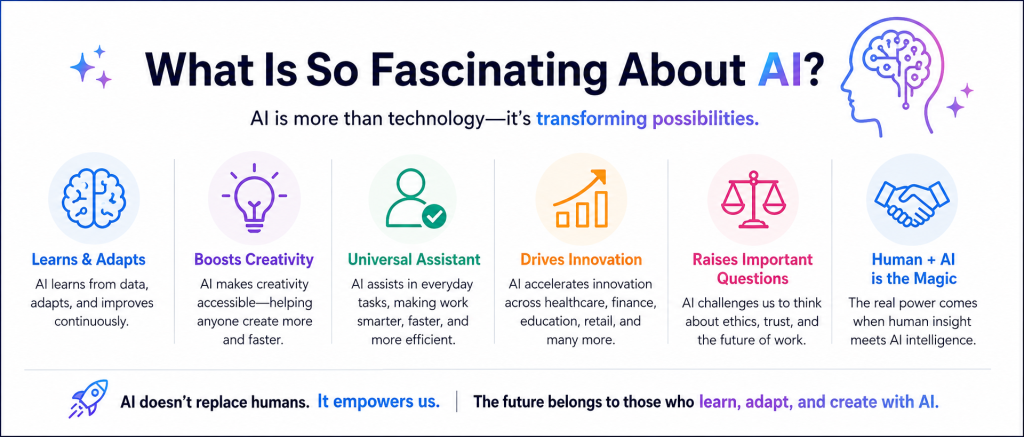
What Is So Fascinating About AI?
It’s Not Just the Technology—It’s the Possibilities
Artificial Intelligence (AI) has become one of the most talked-about technologies of our time. From generating images and writing code to diagnosing diseases and driving business decisions, AI is changing the way we work, learn, and create.
But what exactly makes AI so fascinating?
After spending more than two decades in the IT industry, I’ve seen many technologies emerge—cloud computing, mobile apps, DevOps, big data, and automation. Each transformed the industry in its own way. AI, however, feels different. It’s not just another technological advancement; it’s becoming a collaborative partner that augments human intelligence.
AI Learns Instead of Just Following Instructions
Traditional software is built on predefined rules. Developers tell it exactly what to do, and it executes those instructions.
AI changes this paradigm.
Instead of relying solely on fixed rules, AI identifies patterns from vast amounts of data, adapts, and continuously improves. This ability to learn makes AI far more flexible and capable of solving problems that traditional software struggles to handle.
That’s a fundamental shift in how software behaves.
AI Makes Creativity Accessible
One of the biggest surprises about AI is that it isn’t limited to technical tasks.
Today, anyone can:
- Write blogs in minutes.
- Design professional logos.
- Create marketing campaigns.
- Generate videos and presentations.
- Build websites without writing extensive code.
- Brainstorm business ideas instantly.
Tasks that once required specialized skills are becoming accessible to everyone.
AI isn’t replacing creativity—it lowers the barrier to expressing it.
AI Is Becoming a Universal Assistant
Whether you’re a student, software developer, project manager, entrepreneur, designer, or doctor, AI can assist you.
It can:
- Summarize lengthy documents.
- Draft professional emails.
- Analyze business reports.
- Translate languages.
- Generate code.
- Review contracts.
- Explain complex concepts simply.
Rather than replacing professionals, AI helps them work faster and focus on higher-value thinking.
AI Never Gets Tired of Learning
Unlike traditional systems that remain static until updated, modern AI models continuously improve through research, better training methods, and larger datasets.
Every new generation becomes more capable of:
- Understanding context.
- Solving complex problems.
- Communicating naturally.
- Generating increasingly accurate outputs.
This rapid pace of improvement makes AI one of the fastest-evolving technologies in history.
AI Accelerates Innovation Across Industries
AI’s impact extends far beyond technology companies.
Today it is transforming industries such as:
- Healthcare through faster diagnostics and drug discovery.
- Finance with fraud detection and risk analysis.
- Education through personalized learning experiences.
- Manufacturing via predictive maintenance and quality control.
- Retail using intelligent recommendations and customer insights.
- Agriculture through smart farming and crop monitoring.
Its versatility is what makes AI truly remarkable.
AI Raises Important Human Questions
Perhaps the most fascinating aspect of AI isn’t technical at all.
AI challenges us to rethink:
- What makes humans unique?
- How should we collaborate with intelligent machines?
- Where should ethical boundaries be drawn?
- Which decisions should always remain in human hands?
These questions are shaping conversations among technologists, policymakers, educators, and business leaders worldwide.
The Real Magic Is Human + AI
There’s a common fear that AI will replace people.
In reality, the most successful individuals and organizations are discovering something different.
The real advantage comes from combining:
- Human judgment
- Creativity
- Empathy
- Domain expertise
with AI’s speed, scale, and analytical capabilities.
The future doesn’t belong to AI alone.
It belongs to people who know how to work effectively with AI.
Final Thoughts
What fascinates me most about AI isn’t its ability to generate text, create images, or write code.
It’s the way it expands human potential.
AI allows us to solve bigger problems, make better decisions, learn faster, and create things that once seemed impossible.
Like every major technological revolution, AI will change jobs, industries, and business models. But it also creates enormous opportunities for those willing to learn, adapt, and innovate.
The question is no longer whether AI will transform our world.
It already is.
The more important question is:
How will you use AI to create value—for yourself, your team, and the world around you?