
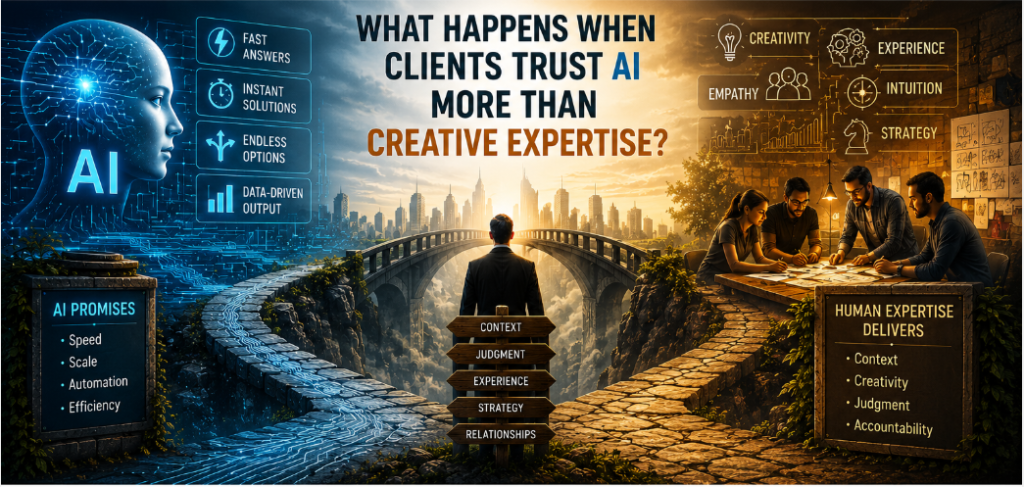
What Happens When Clients Trust AI More Than Creative Expertise?
By an IT Delivery Manager with 20+ Years of Experience
Artificial Intelligence (AI) has transformed the way businesses work. Today, clients can generate project plans, UI designs, technical documentation, marketing copy, and even software code within minutes. The accessibility of AI has created a perception that expertise is becoming less important because “AI already knows the answer.”
As someone who has spent over two decades delivering enterprise solutions across Utilities, BFSI, Insurance, and Education sectors, I’ve observed a different reality.
AI is an exceptional accelerator, but successful project delivery still depends on experience, judgment, collaboration, and accountability.
The New Client Mindset
Many clients now arrive at meetings with AI-generated requirements, architecture suggestions, implementation plans, and effort estimates. While this demonstrates proactive engagement, it also introduces new challenges.
AI provides answers based on patterns learned from existing information. It does not understand an organization’s internal politics, legacy systems, regulatory constraints, business priorities, or long-term strategic goals.
These are areas where experienced professionals continue to make the difference.
The Risk of Blind Trust
One of the biggest risks is assuming that an AI-generated solution is automatically the best solution.
In enterprise software delivery, every recommendation should be validated against questions such as:
- Does it align with business objectives?
- Is it secure and compliant?
- Can existing systems support it?
- What are the operational risks?
- What will the long-term maintenance cost be?
These questions require context that AI alone cannot provide.
Experience Is Context
Throughout my career as a Delivery Manager, I have learned that project success rarely depends on producing the fastest answer. It depends on asking the right questions.
When leading digital transformation projects, I often encounter situations where multiple technical solutions are possible. AI can suggest several approaches, but selecting the right one requires understanding stakeholder expectations, organizational readiness, budget constraints, team capabilities, and future scalability.
That context comes from experience—not algorithms.
AI Doesn’t Own Accountability
If an AI-generated design fails in production, who is responsible?
The answer is never the AI. 🙂
Project managers, architects, delivery managers, and business leaders remain accountable for every decision that reaches production.
This is why governance, reviews, architecture validation, risk management, and quality assurance remain essential, regardless of how much AI is involved.
AI can recommend. People decide.
The Future Delivery Manager
The role of a Delivery Manager is evolving. Instead of spending hours creating project documentation, status reports, or meeting summaries, AI can automate much of this work. This allows delivery leaders to focus on activities that create greater value:
- Building stakeholder trust
- Managing risks proactively
- Resolving conflicts
- Coaching teams
- Driving strategic decisions
- Ensuring successful business outcomes
In many ways, AI is making leadership more important—not less.
Creativity Is Evolving
Creative expertise is no longer about producing content faster. It is about solving problems better.
The professionals who will thrive are those who combine AI’s speed with human insight, empathy, business understanding, and practical experience.
Clients don’t just need answers.
They need confidence that those answers will work in the real world.
Final Thoughts
AI is undoubtedly one of the most transformative technologies of our time, and organizations should embrace it wholeheartedly.
However, trusting AI should never mean replacing professional expertise.
The most successful projects are delivered when AI and experienced professionals work together.
AI provides possibilities. Experts provide judgment.
And in enterprise delivery, judgment is what transforms a good idea into a successful outcome.
As Delivery Managers, our role is no longer to compete with AI—we must lead with it. The future belongs to professionals who know when to rely on AI and, more importantly, when to rely on experience.