
A few days ago, I was trying to understand the difference between AI, GenAI, LLMs, AI Agents, Agentic AI, and Agentic Workflow. I opened articles. I watched videos. I read technical definitions. And honestly? I became more confused. Then I thought of something familiar: a supermarket. Almost everyone has visited one. So, let’s forget the complicated definitions for a few minutes and walk into a supermarket.
Imagine this.
You enter a large supermarket and say to yourself: “I need to buy groceries for dinner tonight.”
Now, let’s see how our supermarket can help us understand the world of AI.
1. AI — The Smart Supermarket
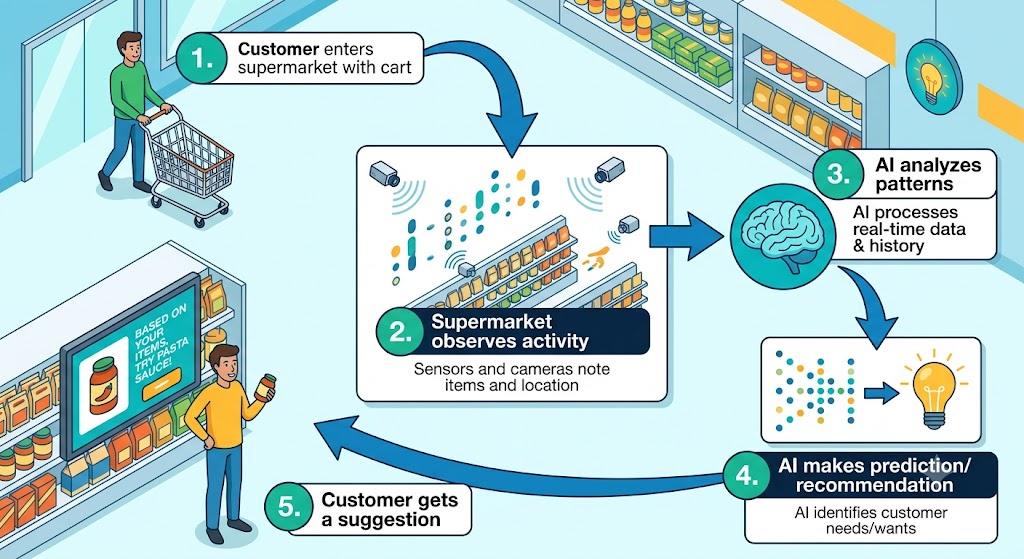
Imagine a supermarket that has become very smart. You walk in, and the supermarket observes what you are doing.
You pick up pasta.
The supermarket knows that people who buy pasta often buy pasta sauce.
So it displays a small suggestion:
“Customers who buy pasta often buy pasta sauce.”
You pick up bread.
It suggests butter.
You buy vegetables.
It reminds you that you haven’t bought cooking oil.
This is our first concept:
AI = The ability to make machines behave intelligently.
The supermarket is using information and patterns to make useful decisions.
It doesn’t necessarily create anything new.
It simply says: “Based on what I know, this is probably useful.”
But now let’s make our supermarket even smarter.
2. LLM — The Supermarket Employee Who Understands You
Imagine there is an employee named Sam at the supermarket.
You don’t have to speak to Sam using complicated words.
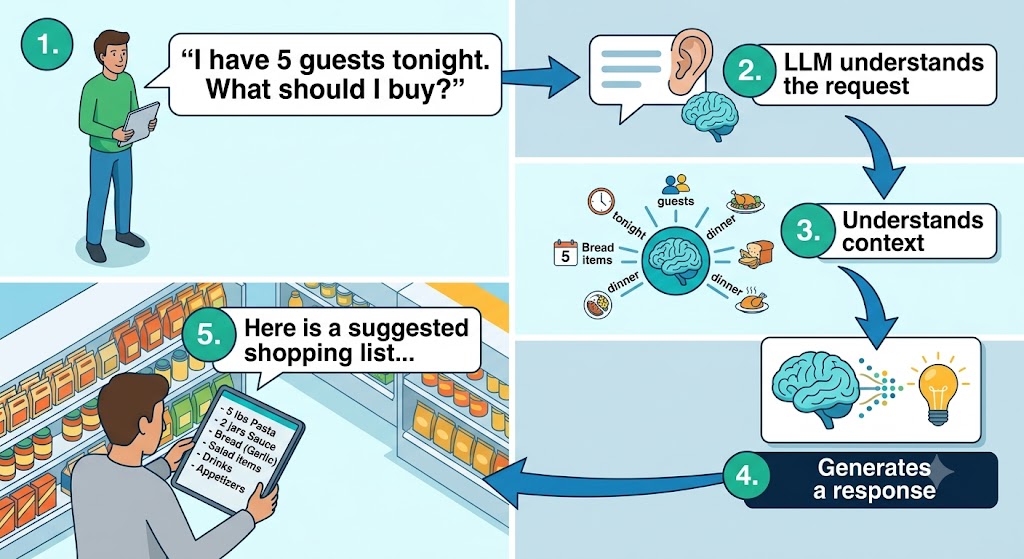
You simply say: “Sam, I have guests coming tonight. What should I buy?”
Sam understands what you mean. He knows that you probably need food, drinks and perhaps some snacks.
You then say: “I have two vegetarian guests.”
Sam adjusts his recommendation.
You say: “One guest doesn’t like spicy food.”
Sam adjusts it again. Sam can understand your language, context and conversation.
This is similar to an LLM — Large Language Model.
An LLM is trained on huge amounts of text and learns patterns in language. It can understand and generate human-like text.
Think of it this way:
LLM = The brain that understands and generates language.
But there is an important point.
Sam can talk to you, but he may not actually go and buy the products for you.
That brings us to GenAI.
3. GenAI — The Supermarket That Creates Something New
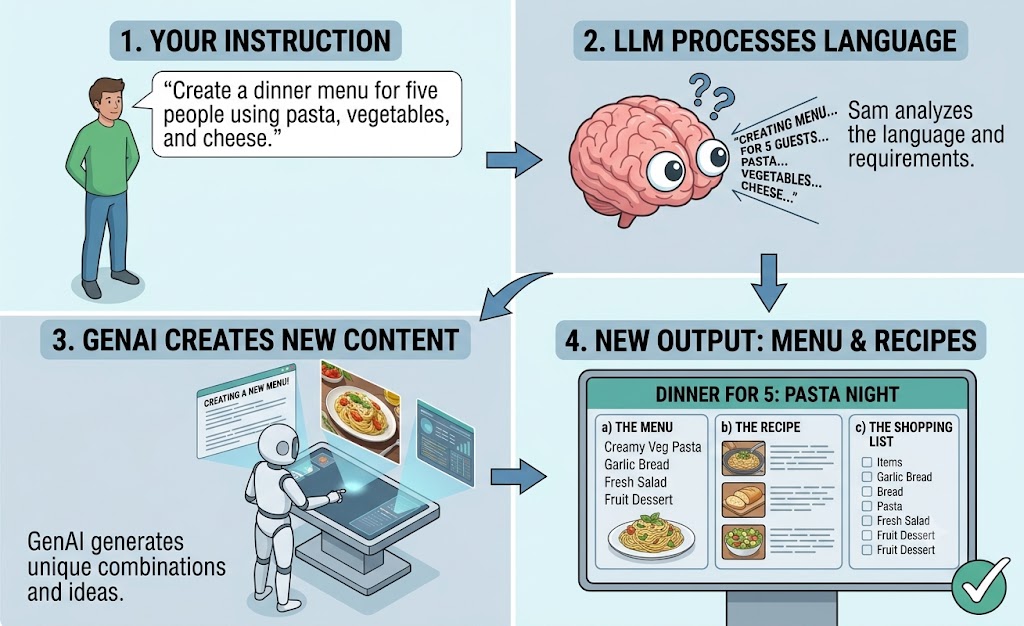
You tell Sam: “Create a dinner menu for five people using pasta, vegetables and cheese.”
Sam doesn’t simply find an existing menu. He creates a new one.
For example:
- Creamy vegetable pasta
- Garlic bread
- Fresh salad
- Fruit dessert
That’s Generative AI.
GenAI = AI that can create new content.
It can generate:
- Text
- Images
- Code
- Audio
- Video
- Summaries
- Ideas
So our supermarket analogy becomes:
Now we have a smart supermarket employee who can understand us and create things. But there’s still a problem. Someone still has to do the work.
4. AI Agent — The Employee Who Takes Action
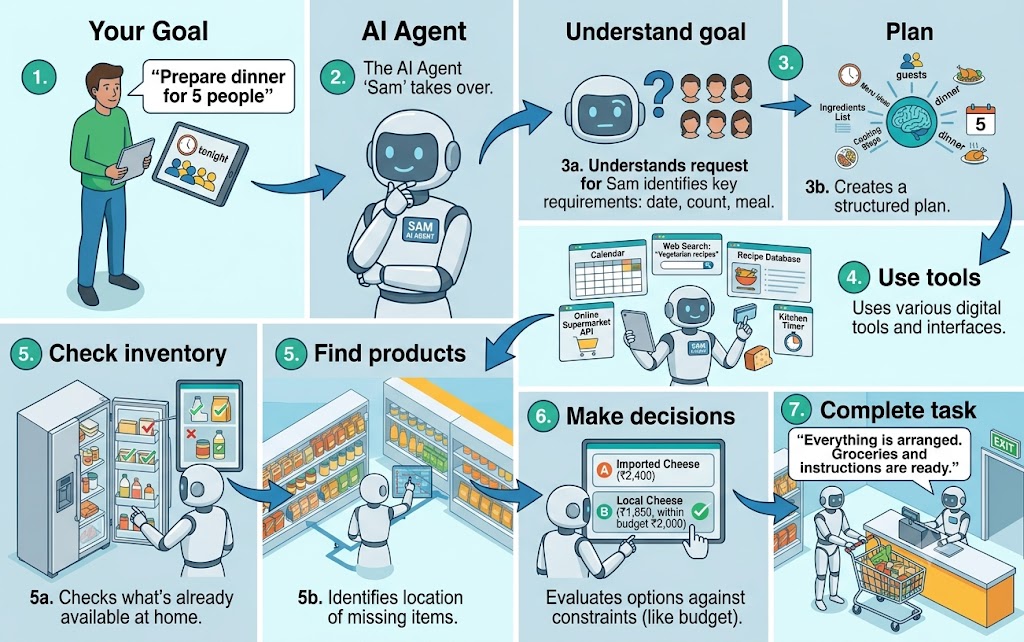
You tell Sam: “I am having five guests tonight. Please arrange everything I need for dinner.”
A normal chatbot might respond: “Sure. Here is a shopping list.”
But an AI Agent can do much more.
Sam thinks: “Five guests. Vegetarian dinner. Let’s figure this out.”
Then he:
- Creates the menu.
- Creates the shopping list.
- Checks the supermarket inventory.
- Finds the required products.
- Checks prices.
- Adds the products to your cart.
- Notices that cheese is unavailable.
- Finds an alternative.
- Shows you the final order.
Now Sam isn’t simply answering. He is acting to achieve a goal. That’s the key idea behind an AI Agent.
AI Agent = An AI system that can reason, use tools and take actions to achieve a goal.
That’s much more powerful than simply asking a question.
5. Agentic AI — Sam Starts Thinking About the Bigger Picture
Now let’s make Sam even smarter.
You say: “Arrange dinner for five people tonight.”
Sam doesn’t just follow one instruction. He thinks about the entire situation.
He considers:
- Number of guests
- Vegetarian preferences
- Available ingredients
- Budget
- Cooking time
- Product availability
- Delivery time
Suppose your budget is ₹2,000. Sam finds that the original menu would cost ₹2,400.
Instead of simply saying: “Your budget is insufficient.”
He thinks: “I can replace an expensive ingredient with a cheaper alternative.”
He changes the menu.
New cost: ₹1,850.
He achieves the goal while respecting your constraint. This is where the idea of Agentic AI becomes interesting.
Agentic AI = AI that can pursue a goal with a degree of autonomy, making decisions and taking actions along the way.
The important word is: Goal.
Traditional AI often answers: “What is the answer?”
Agentic AI is closer to: “What needs to be done to achieve the goal?”
6. Agentic Workflow — The Complete Journey
Now imagine the supermarket has several smart employees.
- One understands your request.
- Another checks inventory.
- Another checks prices.
- Another handles payment.
- Another arranges delivery.
You say: “I need dinner for five people tonight.”
The system creates a complete workflow.
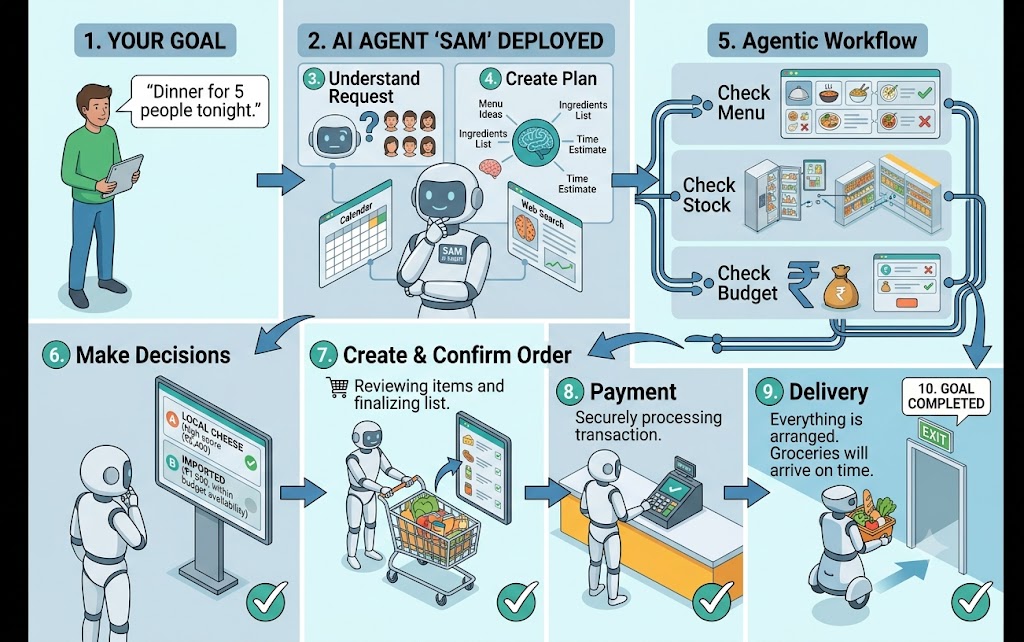
This is an Agentic Workflow.
It is a sequence of actions where AI can determine what needs to happen next, use different tools or systems, evaluate results, and continue until the objective is achieved.
7. So What’s the Difference?
Let’s stand outside our supermarket for a moment.
Here is the simplest way I remember it:
Concept | Supermarket Example |
AI | Smart supermarket that recognizes patterns |
LLM | Employee who understands and generates language |
GenAI | Employee who creates a new menu or recipe |
AI Agent | Employee who can take actions to complete a task |
Agentic AI | Employee who can autonomously plan and make decisions toward a goal |
Agentic Workflow | The complete chain of planning, actions, decisions, and tools used to achieve the goal |
8. A short recap of above.
Imagine you walk into the supermarket.
You say:
You: “I’m having five friends over tonight. Can you arrange dinner?”
LLM: “I understand what you’re asking.”
GenAI: “Here’s a suitable dinner menu.”
AI Agent: “I’ll check what we need and arrange it.”
Agentic AI: “Some ingredients are unavailable and the original menu exceeds your budget. I’ll adjust the plan.”
Agentic Workflow: “Menu → Inventory → Alternatives → Price → Cart → Payment → Delivery.”
And finally:
Sam: “Everything is arranged. Your groceries will arrive at 6:30 PM.”
You didn’t tell Sam every individual step. You gave him a goal. That’s the big idea behind the move from traditional AI toward Agentic AI.
Remembering Tips:-
If you remember nothing else, remember this:
AI → Makes machines intelligent
LLM → Understands and generates language
GenAI → Creates new content
AI Agent → Understands a goal and takes actions
Agentic AI → Plans, decides and acts with greater autonomy
Agentic Workflow → Connects all those actions into an end-to-end process
So the next time you hear words like LLM, GenAI, AI Agent or Agentic AI, don’t think about complicated technical definitions.
Think about Sam at the supermarket. The more capable Sam becomes, the less you need to tell him how to do something. You simply tell him what you want to achieve.
And that’s, in very simple terms, the fascinating journey from AI that answers questions to AI that can help accomplish goals.